Tag: grammar

  • Layed or laid: What Is the Difference?
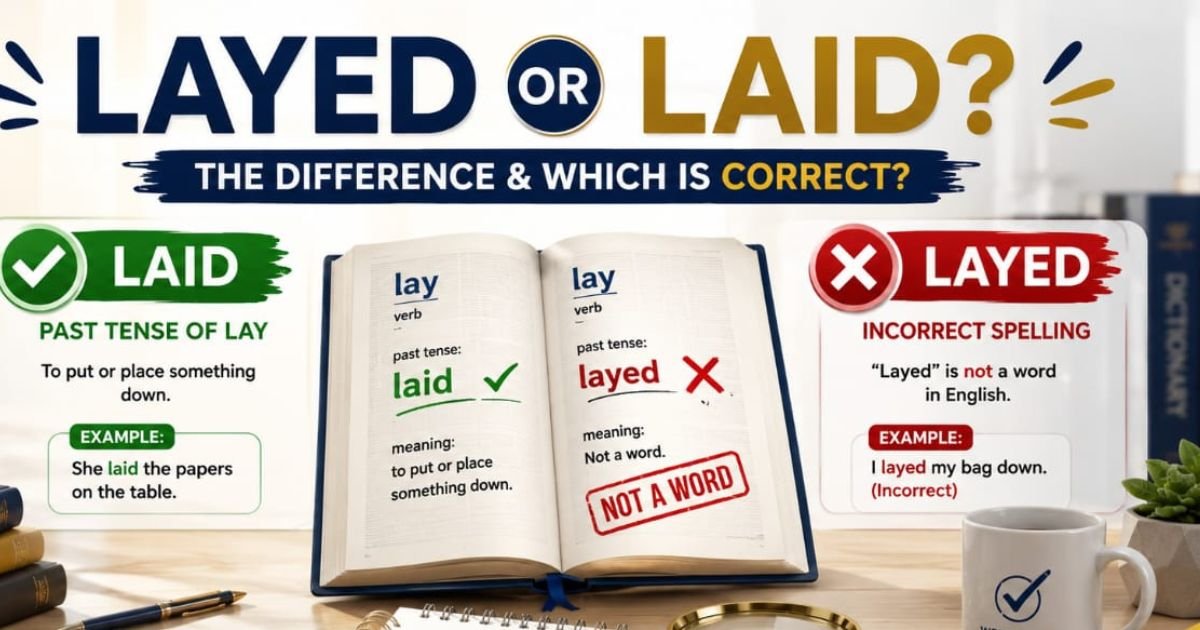
    “Layed” or “laid” — which one is correct?”Laid” is the correct past tense of the verb “lay,” while “layed” is a common misspelling that doesn’t actually exist in English. This article breaks down the difference in simple terms, explains why so many people get it wrong, and helps you pick the right word without second-guessing yourself.

    Comparison Overview

    Only “laid” is a real English word. “Layed” shows up often in casual writing, text messages, and even social media posts, but no dictionary recognizes it as correct. The confusion mostly comes from how English usually forms past tense — by adding “-ed” to a verb. Since “lay” is an irregular verb, it breaks that normal pattern, and that’s exactly where people slip up.

    Definition of “Layed”

    There isn’t one. “Layed” has no dictionary definition because it isn’t an accepted English word. It’s simply a spelling error that happens when someone tries to add “-ed” to “lay” the same way they would with regular verbs like “walked” or “talked.” Whenever you see “layed” in a sentence, it should be replaced with “laid.”

    Definition of “Laid”

    “Laid” is the correct past tense and past participle of the verb “lay.” The verb “lay” means to place or put something down. Major dictionaries confirm this: and the Cambridge Dictionary both list “laid” as the only accepted past tense and past participle form of “lay.”

    Example in Use

    • She laid her phone on the counter before she left.
    • He laid the tools back in the box after finishing the repair.

    Main Difference Between “Laid” and “Layed”

    WordStatusMeaning
    LaidCorrectPast tense of “lay,” meaning to place something down
    LayedIncorrectNot a real word; always a misspelling of “laid”

    There’s no situation, formal or informal, where “layed” is the right choice.

    Grammar Guide

    The Full Verb Pattern

    • Base form: lay — I lay the book on the shelf every day.
    • Past tense: laid — I laid the book on the shelf yesterday.
    • Past participle: laid — I have laid the book on the shelf many times.
    • Present participle: laying — I am laying the book on the shelf right now.

    “Lay” vs. “Lie” — Don’t Mix Them Up

    “Lay” is different from “lie,” which means to recline or rest. The verb “lie” has its own past tense forms: lie, lay, lain. This overlap is part of why people get confused in the first place. Style authorities like the Oxford English Dictionary and The Chicago Manual of Style both treat “lay” and “lie” as distinct irregular verbs, and neither recognizes “layed” in any form.

    When to Use Each One

    Use “laid” whenever you’re describing the act of placing, putting, or setting something down in the past.

    • The workers laid the bricks carefully.
    • She laid the baby down for a nap.
    • The bird has laid two eggs this week.
    • He laid his jacket over the chair before sitting down.
    • The waiter laid the menus on the table.

    When NOT to Use Each One

    Never use “layed” — in any sentence, tense, or context. It’s incorrect every single time.

    Don’t Confuse It With “Lie”

    • Incorrect: He laid down on the couch after work. → Correct: He lay down on the couch after work.
    • Incorrect: The dog layed in the sun all afternoon. → Correct: The dog lay in the sun all afternoon.

    Which One to Use (Decision Guide)

    Ask yourself: Am I talking about placing an object down, in the past?

    • If yes, use “laid.”
    • If you’re about to type “layed,” stop. It’s always wrong. Replace it with “laid.”
    • If you’re talking about a person or animal reclining in the past, use “lay,” not “laid.”

    Real-World Practical Examples

    Everyday Situations

    • The chef laid the plates on the table before the guests arrived.
    • Yesterday, the cat lay on the windowsill for hours.
    • The construction crew laid the foundation last month.
    • She has laid out her clothes for tomorrow’s meeting.
    • After the long trip, he lay down and fell asleep instantly.

    Workplace and Formal Examples

    • The manager laid out the new project plan during the meeting.
    • The company laid off several employees last quarter.
    • The architect laid the blueprints across the desk for review.
    • The nurse laid the patient’s chart on the table before the checkup.

    [Suggested image placement: an infographic summarizing the “lay/laid/laying” verb pattern, with alt text “layed vs laid grammar comparison chart.”]

    Self-Assessment (Fill in the Blanks)

    • Yesterday, she _______ the flowers on the grave.
    • He _______ down for an hour after lunch.
    • The hen has _______ an egg every morning this week.
    • They _______ the carpet down before the guests arrived.
    • I _______ awake all night thinking about the exam.
    • The painter _______ his brushes down after finishing the wall.
    • Last summer, the dog _______ under the tree all day.
    • She _______ the baby in the crib gently.
    • He _______ still on the grass, watching the clouds.
    • The builders _______ the pipes underground last week.

    Answers

    1. laid | 2. lay | 3. laid | 4. laid | 5. lay | 6. laid | 7. lay | 8. laid | 9. lay | 10. laid

    Final Verdict

    “Laid” is the only correct choice when you’re describing the past tense of placing something down. “Layed” is not a real word and should never appear in your writing, no matter how natural it might feel to type it.

    FAQs

    1. Is “layed” ever correct?

    No. “Layed” is not a recognized word in English under any circumstance.

    2. What is the past tense of “lay”?

    The past tense of “lay” is “laid.”

    3. What’s the difference between “lay” and “lie”?

    “Lay” means to place something down and needs an object. “Lie” means to recline and doesn’t need an object.

    4. Is “laid” used in both British and American English?

    Yes, “laid” is standard in both British and American English.

    5. How can I remember the difference between “layed” and “laid”?

    Just remember: “lay” is irregular, so it never takes a regular “-ed” ending. The only past tense form is “laid.”

    6. What is the past participle of “lay”?

    The past participle of “lay” is also “laid,” the same as the simple past tense.

    7. Can “laid” be used as an adjective?

    Yes, in phrases like “well-laid plans,” “laid” is used descriptively to mean something was carefully arranged.

    8. Why do so many people write “layed” instead of “laid”?

    Because most English verbs form the past tense by adding “-ed,” so people naturally assume “lay” follows the same rule, but it’s irregular.

    9. Is “lay” the same word in “lay down” and “lay an egg”?

    Yes, it’s the same verb “lay,” meaning to place something down, whether that “something” is a person, object, or an egg.

    10. What is a simple trick to avoid using “layed”?

    Whenever you’re unsure, replace the sentence with “placed” or “put.” If it makes sense, “laid” is almost certainly the word you need, never “layed.” Resources like Grammarly’s grammar handbook offer more practice examples if you want extra reinforcement.

    Conclusion

    The difference between “layed” and “laid” comes down to one simple fact: only “laid” exists in the English language. Once you remember that “lay” is an irregular verb and doesn’t follow the usual “-ed” pattern, this mistake becomes easy to avoid.