
Both work for me” or “both works for me” – which one is correct? If you’ve typed this and paused, wondering whether to add an “s,” you’re not alone. This is one of the most common subject-verb agreement mistakes in English, made by both native and non-native speakers. In this guide, you’ll learn which phrase is correct, why the rule works, and how to avoid making the same mistake in the future.

Quick Answer:
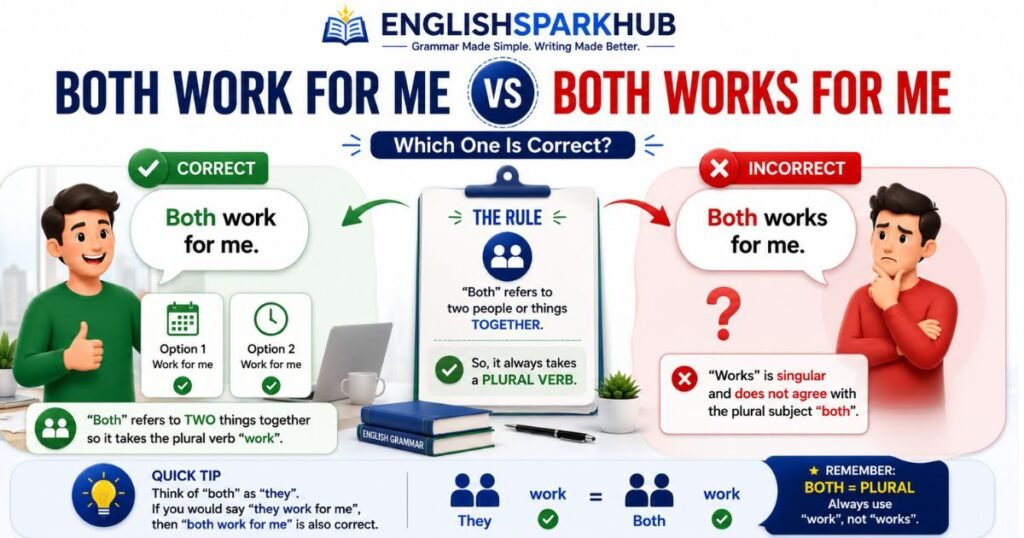
Both work for me” is the grammatically correct phrase. “Both works for me” is incorrect because “both” is always a plural subject and therefore requires the plural verb “work,” not “works.” This rule applies in both formal and informal English, including emails, conversations, and professional writing.
Quick tip: Think of “both” as “they.” If you would say “they work for me,” then “both work for me” is also correct.
| Phrase | Correct? | Reason |
| Both Work for me | Correct | “Both” refers to two things, so it takes the plural verb “work.” |
| Both works for me | incorrect | Works is singular and does not agree with the plural subject both. |
Whenever the subject is both always use the plural verb work,not works.
Understanding “Both” – Is It Singular or Plural?
“Both” is a determiner and pronoun that always refers to two people or things together. Whether you’re talking about people, objects, ideas, or choices, “both” always refers to two items as a pair rather than a single item.
This makes “both” different from words like “each” or “either,” which consider one item at a time, even when only two options are involved. Instead of separating the two, “both” groups them together as a plural unit.
For this reason, “both” always takes a plural verb, just like they, we, and many. This is the grammar rule that makes “both work for me” correct and “both works for me” incorrect.
The Subject-Verb Agreement Rule Behind It
The difference between “both work for me” and “both works for me” comes down to one basic grammar rule: subject-verb agreement. In English, a verb must agree with its subject in number. Singular subjects take singular verbs, while plural subjects take plural verbs.
Compare these examples:
- She works. (singular subject + singular verb)
- They work. (plural subject + plural verb)
- Both work. (plural subject + plural verb)
Since “both” always refers to two people or things, it is treated as a plural subject. As a result, it always takes the plural verb “work,” not “works.” Once you understand this rule, choosing the correct phrase becomes straightforward.
Why “Both Work for Me” Is Correct
The phrase “both work for me” is correct because “both” is a plural subject and therefore requires the plural verb “work.” You use this expression when two options, choices, or possibilities are equally acceptable to you.
For example, if someone offers you two meeting times, two travel plans, or two product options, saying “both work for me” means you are happy with either choice and have no particular preference.
Here are a few examples:
- Both work for me. Let me know which one you’d like to choose.
- I checked the two flight times, and both work for me.
- We reviewed two logo designs, and both work for me equally well.
- Either meeting time is fine because both work for me.
In each example, “both” represents two things together, so the verb “work” is the only grammatically correct choice.
Why “Both Works for Me” Feels Right (But Isn’t)
If “both works for me” sounds natural to you, you’re not alone. This is a common mistake made by both English learners and native speakers because the brain often relies on familiar speech patterns rather than grammar rules.
In English, singular subjects such as he, she, and it take verbs ending in -s, as in he works or she works. Since “both” is a single word, some people instinctively treat it like a singular subject and add -s to the verb.
However, “both” never refers to one person or one thing. It always refers to two people or things together, making it a plural subject. That is why the correct form is “both work for me,” not “both works for me.”
Understanding why this mistake happens makes it much easier to spot and avoid in your own writing and speech.
“Both” vs. “Each” – The Real Source of Confusion
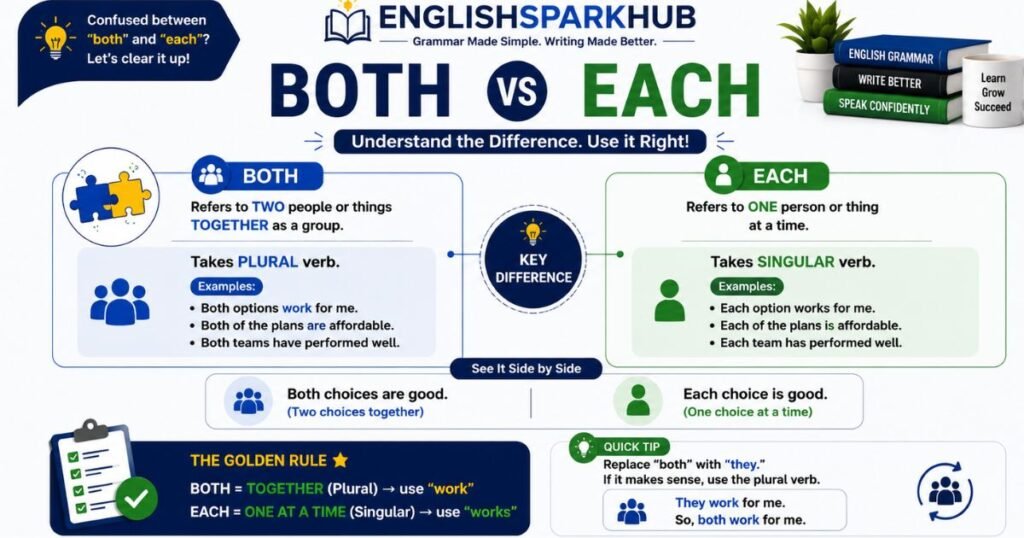
Many people confuse “both” and “each” because both can refer to the same two items. However, they follow different grammar rules.
“Each” focuses on one person or thing at a time, even when there are two or more in total. That’s why it always takes a singular verb.
Example:
Each of the plans works for our budget.
“Both,” on the other hand, refers to two people or things together as a group. Because it is plural, it always takes a plural verb.
Example:
Both of the plans work for our budget.
This difference explains why some people mistakenly write “both works for me.” They unconsciously apply the singular verb pattern used with “each.” Once you remember that each = singular and both = plural, choosing the correct verb becomes much easier.
“Both” with a Noun in Between
Sometimes “both” comes directly before a noun instead of standing alone. For example, you might say both options, both times, or both cities. Even in these cases, the grammar rule remains exactly the same.
Because “both” still refers to two people or things, the verb must stay plural.
Examples:
- Both options work for me.
- Both meeting times work for our schedule.
- Both cities have excellent public transport.
- Both restaurants serve great food.
Whether “both” is used on its own or followed by a noun, it always takes a plural verb. That’s why “both work for me” and “both options work for me” are both grammatically correct.
“Both” as a Pronoun vs. a Determiner
The word “both” can function as either a pronoun or a determiner, but the grammar rule stays the same in both cases. It always refers to two people or things, so it always takes a plural verb.
As a Pronoun
When “both” replaces a noun that has already been mentioned, it acts as a pronoun.
Example:
I looked at the two contracts. Both work for me.
As a Determiner
When “both” comes directly before a noun to describe it, it functions as a determiner.
Example:
Both contracts work for me.
Although the grammatical role changes, the verb does not. Whether “both” is used as a pronoun or a determiner, the correct form is always “work,” not “works.”
Comparing “Both,” “Each,” “Either,” “Neither,” and “All”
These words are often confused because they all refer to one or more people or things. However, they do not all follow the same subject-verb agreement rule.
| Word | Verb | Example |
| Both | Plural | Both Work for Me. |
| Each | Singular | Each works for me. |
| Either | Singular | Either works for me. |
| Neither | Singular | Neither works for me. |
| All | Plural | All work for me. |
The easiest way to remember this rule is that both and all always take plural verbs, while each, either, and neither take singular verbs. Once you understand this pattern, choosing the correct verb becomes much easier.
Formal Writing vs. Casual Conversation:
In everyday conversation, you may occasionally hear someone say “both works for me.” Native speakers sometimes make small grammar slips when speaking spontaneously, and such mistakes often go unnoticed.
However, in formal writing, the correct form is always “both work for me.” Whether you’re writing an email, a report, an assignment, or a professional message, using the correct subject-verb agreement makes your writing clearer and more credible.
Even in casual situations, using “both work for me” is considered the standard and grammatically correct choice.
Does British English Differ from American English Here?
No. This grammar rule is the same in British English, American English, Australian English, and other standard varieties of English. In every case, “both” is treated as a plural subject, so the correct phrase is “both work for me.”
There are no regional exceptions to this rule, which means you can confidently use “both work for me” regardless of which variety of English you’re writing or speaking.
Real-Life Examples Across Different Situations:
Here are some common situations where “both work for me” is used naturally in everyday English.
At Work.
“I have two meeting slots available on Thursday. Both work for me, so you can choose whichever is more convenient.”
Travel Planning.
“We’re deciding between the morning and evening flights. Both work for me, so I’m happy with either one.”
Ordering Food.
“Whether we order pizza or tacos, both work for me. I’m fine with either choice.”
Shopping.
“I’m choosing between the blue and grey sofa. Both work for me with the rest of the furniture.”
Social Plans.
“We can meet on Friday or Saturday. Both work for me. Just let me know what suits you best.”
These examples all follow the same rule: because “both” refers to two options, the verb remains “work,” not “works.”
Other Common “Both” Mistakes
The same subject-verb agreement rule applies to other verbs as well. Since “both” is always plural, it must be paired with plural verb forms.
| Incorrect | Correct |
| Both is correct. | Both are correct. |
| Both has arrived. | Both have arrived. |
| Both was ready. | Both were ready. |
| Both works for me. | Both work for me. |
If you remember one rule, make it this: whenever the subject is “both,” use a plural verb. This simple guideline will help you avoid several common grammar mistakes, not just “both work for me” versus “both works for me.”Verb form confusion isn’t limited to “both” – similar mix-ups happen with irregular verbs too, like froze or frozen. Spelling mistakes like layed or laid are just as common among learners and native speakers alike, so it’s worth brushing up on these related errors as well.
Quick Self-Check Trick to Never Get It Wrong Again
A simple way to check whether you’ve chosen the correct verb is to replace “both” with “they.” If the sentence still sounds correct, you’ve used the right verb.
For example:
– Both work for me. → They work for me. ✅
– Both works for me. → They works for me. ❌
Since “they work” is the correct form, “both work” must also be correct.
Whenever you’re unsure, use this quick substitution trick before sending an email, submitting an assignment, or publishing a piece of writing. It takes only a few seconds and helps you avoid one of the most common subject-verb agreement mistakes.
FAQs
1. What is the correct phrase: “Both work for me” or “Both works for me”?
The correct phrase is “both work for me.” Since “both” refers to two people or things, it is a plural subject and must take the plural verb “work.” The phrase “both works for me” is grammatically incorrect because “works” is a singular verb.
2.Why do people say “both works for me”?
Many people make this mistake because they are used to hearing singular verb forms such as “he works” or “it works.” Since “both” is a single word, it is sometimes mistakenly treated as singular, even though it always refers to two things and requires a plural verb.
3.Can native English speakers say “both works for me”?
Yes, native speakers can occasionally say “both works for me” in casual conversation as a grammar slip. However, the standard and grammatically correct form is “both work for me,” especially in formal writing, business communication, and academic work.
4.Can I say “both of them work for me” instead of “both work for me”?
Yes. Both expressions are grammatically correct. “Both work for me” is shorter and more natural when the context is already clear, while “both of them work for me” adds extra emphasis or clarity when needed.
5.Is “both work for me” appropriate in professional emails?
Absolutely. “Both work for me” is the correct phrase to use in emails, meetings, interviews, and workplace communication. It clearly tells the other person that either of the two options is acceptable to you.
6.Does the rule change if “both” is followed by a noun?
No. The rule stays the same. Whether you write “both work for me” or “both options work for me,” the verb must remain plural because “both” always refers to two people or things.
7.Is this rule different in British English and American English?
No. The rule is the same in both British English and American English, as well as other standard varieties of English. In every case, “both” is treated as a plural subject and takes the plural verb “work.”
Conclusion
In summary, the difference between “both work for me” and “both works for me” comes down to one simple grammar rule: subject-verb agreement. Because “both” refers to two people or things, it is always treated as a plural subject and must take the plural verb “work.” That’s why “both work for me” is correct, while “both works for me” is grammatically incorrect.
If you’re ever unsure, use this simple trick: replace “both” with “they.” If “they work” sounds right, then “both work” is also correct. By remembering this easy rule, you’ll avoid a common grammar mistake and write with greater clarity and confidence in emails, conversations, academic assignments, and professional communication.Looking for more grammar clarity? Check out our guide on company wide vs companywide to clear up another commonly confused phrase.