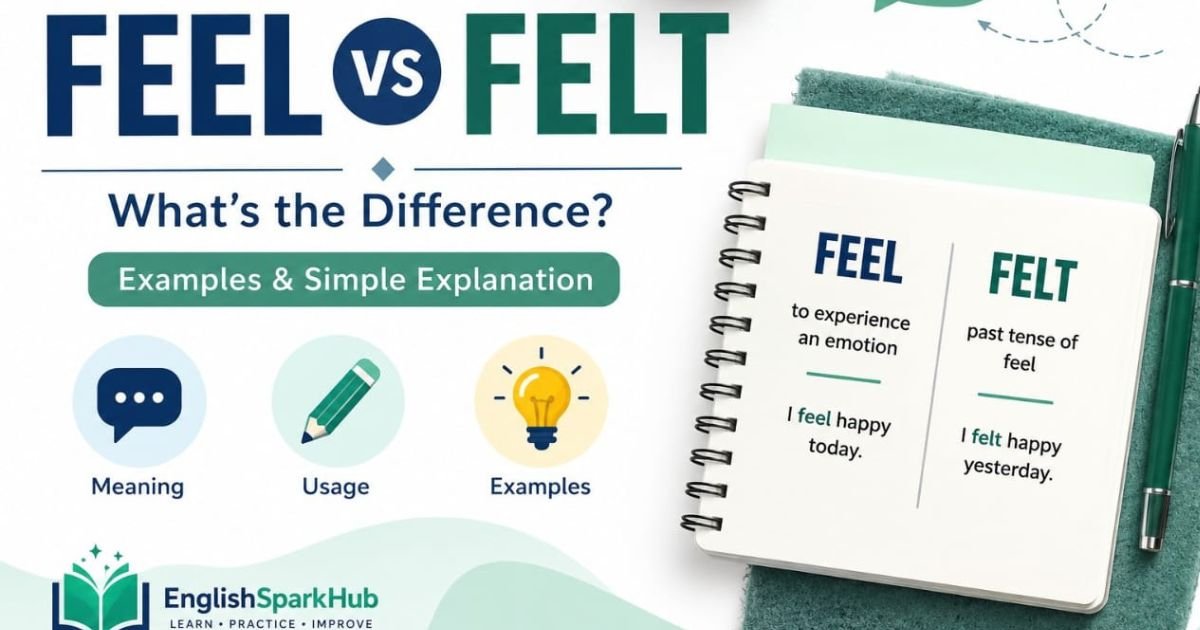
Feel vs Felt look similar, but they belong to two different tense.These two words are closely related, yet they serve different grammatical purposes. Feel is used to describe a present emotion, sensation, or opinion, while felt refers to something experienced in the past. In this article, we’ll break down the difference between felt and feel, explain the grammar rules, and provide clear examples to help you use both words correctly and confidently.
What Does “Feel” Mean?
The word “feel” is a versatile verb used to describe what we experience physically and emotionally. It can express physical sensations, such as feeling warm or cold, as well as emotions like happiness or sadness. We can also use “feel” to express an opinion or personal view. For example, you might say, “I feel cold” to describe a physical sensation, “I feel happy” to express an emotion, or “I feel that this movie is interesting” to share an opinion. Understanding these different uses of “feel” will help you use the word naturally and confidently in everyday English.
Feel, Felt, Feeling: The 3 Forms of Feel
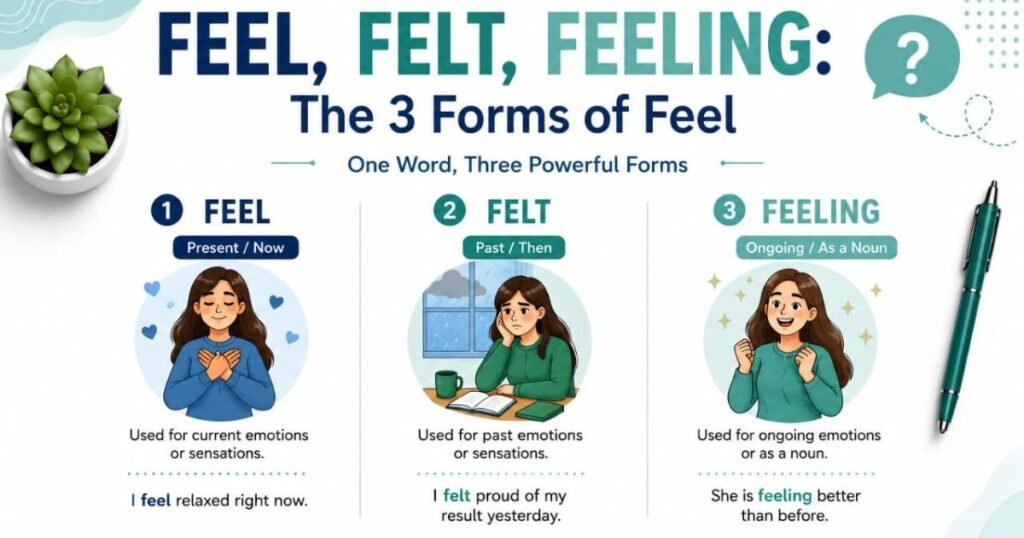
The verb “feel” is irregular and comes in three main forms: “feel,” “felt,” and “feeling.” The base form “feel” is used in the present tense, while “felt” is the past form that describes a completed
| Forms | Tense/ Use | Example Sentence |
| Felt | Past | She felt tired. |
| Feel | Present | I feel happy. |
| Feeling | Continuous/ongoing | He is feeling better. |
Explanation of Felt
“Felt” is the past tense and past participle form of the verb “feel.” You use “felt” to talk about physical sensations, emotions, or opinions that happened in the past. For example, you can say, “I felt the warm sun on my skin,” to describe a physical sensation. Or, “I felt sad when my friend moved away,” which expresses an emotion. Lastly, “I felt that the movie was boring,” shows an opinion about something you experienced earlier. Understanding “felt” will help you communicate your thoughts and feelings better.
Feel vs Felt: A Simple Comparison.
| Word | Tense | Meaning | Example Sentence |
| Feel | Present | To sense or experience emotions. | I feel happy today. |
| Felt | Past | To have sensed or experienced emotions. | Yesterday. I felt tired after work. |
When to Use Feel vs Felt (With Examples).
Understanding the difference between “feel” and “felt” can save you from confusing your listeners and readers. These two words may seem similar, but they serve different purposes in English. Use “feel” for current emotions and general truths, while “felt” is reserved for past experiences. For example, you might say, “I feel happy today” to express a current emotion, but recall, “I felt sad yesterday” when discussing the past. This knowledge is essential for clear communication in both speaking and writing.
Feel Vs Felt in Present and Past Tense.
Feel vs Felt in Present and Past Tense
The words “feel” and “felt” show how we talk about emotions in different time frames. “Feel” is used when we talk about what is happening now, while “felt” is used for things that happened before. For example:
- I feel happy.
- I felt happy yesterday.
Here, “feel” indicates a current emotion, while “felt” describes a past experience. Another pair could be:
- She feels sad.
- She felt sad last week.
By understanding how these words change with time, you can express your feelings more clearly in English.
How to Use Feel and Felt in a Sentence
Using “feel” and “felt” correctly is essential for expressing emotions in English. The basic structure is simple: Subject + feel/felt + adjective/noun/phrase. For example, you can say “I feel happy,” “You felt sad,” or “She feels excited.” Notice that “feel” is used for present emotions, while “felt” is for past emotions. Regardless of the subject, the verb stays the same — avoid saying “feels” or “felted.” Here are more examples: “He feels good,” “They felt surprised,” and “We feel tired.” This pattern will help you speak and write confidently.
Feel vs. Felt in Questions and Negative Sentences
“Feel” and “felt” can be tricky for many learners, especially when they are used in questions and negative sentences. “Feel” is used for the present tense, while “felt” refers to the past.
Using “Feel” and “Felt” in Questions
To form questions, use helping verbs such as “do” or “does” for the present tense and “did” for the past tense.
- Do you feel happy?
- Did you feel sad yesterday?
Using “Feel” and “Felt” in Negative Sentences
For negative sentences, use “don’t” or “doesn’t” for the present tense and “didn’t” for the past tense.
- I don’t feel tired.
- She didn’t feel well last week.
Using these structures correctly helps you express your feelings clearly and accurately.
Why Is “Did You Feel” Correct, Not “Did You Felt”?
Learning English can sometimes feel overwhelming, especially when it comes to grammar rules. One common mistake learners make is confusing forms of verbs in questions. Today, we’ll focus on why we say “Did you feel” instead of “Did you felt.” Knowing these small details can boost your confidence in using English effectively.
Can You Use “Feel” in Future or Modal Sentences?
Have you ever wondered how to express your emotions about the future in English? Understanding how to use the verb “feel” correctly can open new doors in your speaking and writing. In this article, we’ll explore how you can use “feel” with modal verbs like will, can, and might. This knowledge will help you communicate more clearly and confidently. By the end, you’ll be able to construct sentences that describe future emotions with ease.
Feel Like Vs Felt Like
English can be tricky, especially with phrases that seem so simple! One common pair is “feel like” and “felt like.” Understanding these can help you express desires and sensations clearly. In this article, we will break down both phrases and show you how to use them in daily conversation. By the end, you’ll have the confidence to talk about what you want and how things feel.
Feel vs Felt for Emotions, Sensations, and Opinions
The words “feel” and “felt” are important in English. They help us talk about our emotions, physical sensations, and opinions.
1. Emotions
We use “feel” to talk about emotions in the present.
- I feel happy.
- I feel sad.
We use “felt” to talk about emotions in the past.
- I felt happy yesterday.
- I felt sad after the news.
2. Sensations
We use “feel” to talk about physical sensations in the present.
- I feel cold.
- She feels tired.
- I feel pain in my leg.
We use “felt” to talk about physical sensations in the past.
- I felt cold last night.
- She felt tired after work.
- I felt pain yesterday.
3. Opinions
“Feel” and “felt” can also be used to express opinions or beliefs. In this context, “feel” can mean “think” or “believe.”
We use “feel” for present opinions.
- I feel this is correct.
- I feel that we should wait.
We use “felt” for past opinions.
- I felt it was the right choice.
- I felt that something was wrong.
Understanding these three uses of “feel” and “felt” makes it easier to express emotions, physical sensations, and opinions clearly in English
Common Mistakes with Feel and Felt
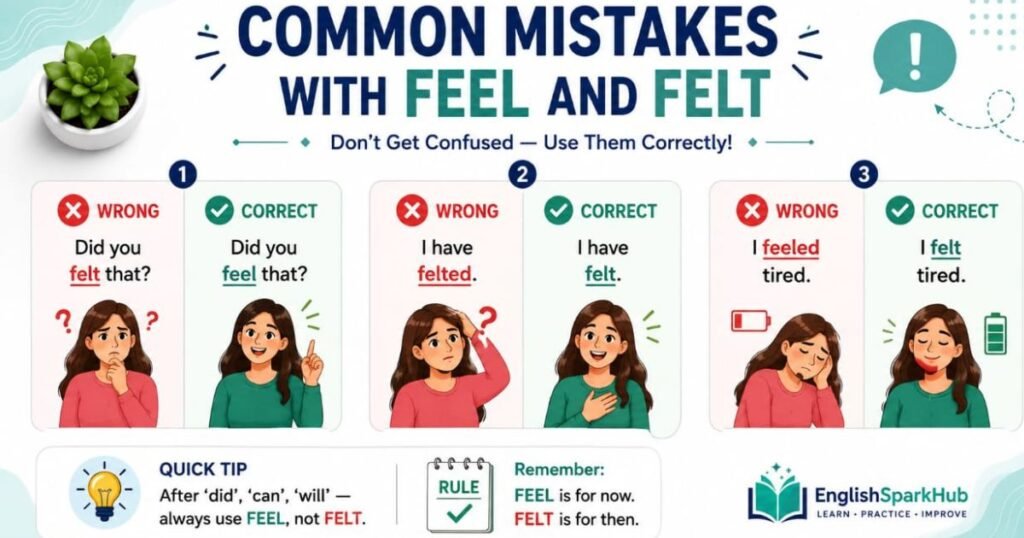
Common mistakes with “feel” and “felt” can lead to confusion. Let’s take a look at some errors that many learners make. Imagine you’re chatting with friends, and someone makes a grammar mistake like “I have felted tired.” It’s easy to feel embarrassed, right? Many English learners mix up “feel” and “felt,” leading to confusion. This article will show you how to avoid these common pitfalls. With a little practice, you’ll sound more fluent and confident.
Using “felted” instead of “felt.”
- Wrong: “I have felted happy today.”
- Correct: “I have felt happy today.”
- Why: The past participle of “feel” is “felt,” not “felted.”
Saying “did you felt” instead of “did you feel.”
- Wrong: “Did you felt that too?”
- Correct: “Did you feel that too?”
- Why: After “did,” we always use the base form of the verb, so we use “feel,” not “felt.”
Confusing “feel” with “feels” after modal verbs.
- Wrong: “I can feels you.”
- Correct: “I can feel you.”
- Why: Modal verbs such as “can” are followed by the base form of the verb.
Mixing up “feel like” with wrong verb forms.
- Wrong: “I feel like to go home.”
- Correct: “I feel like going home.”
- Why: When “feel like” is followed by a verb, we use the -ing form.
Using “I feeled” instead of “I felt.”
- Wrong: “Yesterday, I feeled tired.”
- Correct: “Yesterday, I felt tired.”
- Why: “Felt” is the correct past form of “feel.” “Feeled” is not correct.
Recognizing these errors will help you communicate more effectively in English.
Feel vs Felt in Everyday English
“Feel” and “felt” are common words in everyday English, but knowing when to use each one can sometimes be confusing. Understanding the difference between them can greatly improve your speaking skills. In this article, we’ll break down their ways of usage in daily conversations. Soon, you’ll find it easy to express your feelings, describe your health, and talk about the weather.
Easy Way to Remember Feel vs Felt
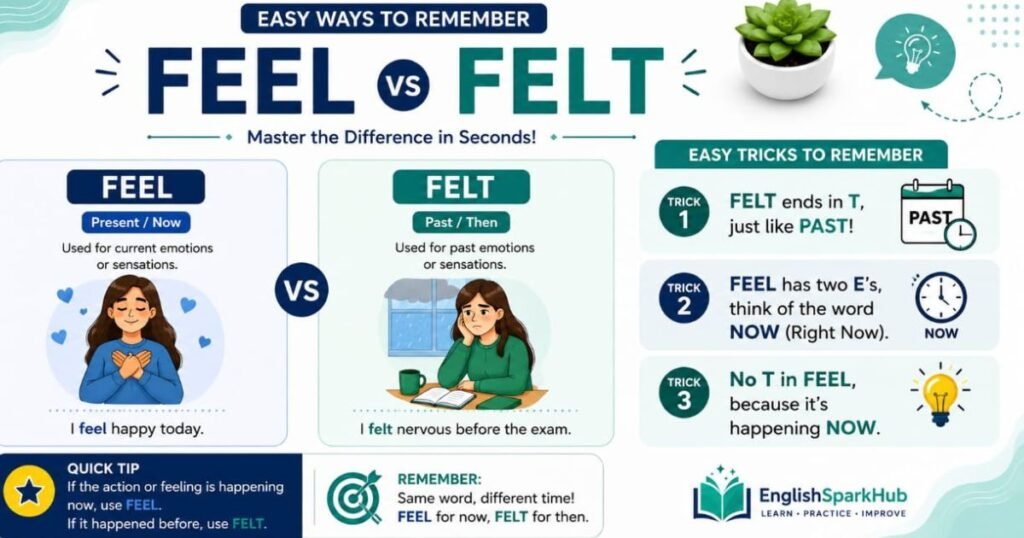
Understanding when to use “feel” and “felt” can help you express your feelings better in English. “Feel” is used for the present, while “felt” is for the past. Think of it this way: “felt” ends with a ‘t’, just like the word “past.” Another fun trick is to remember that “I feel” is like saying “I am feeling now,” making it current. With these simple tips, you’ll never mix them up again.
Practice: Feel vs Felt?
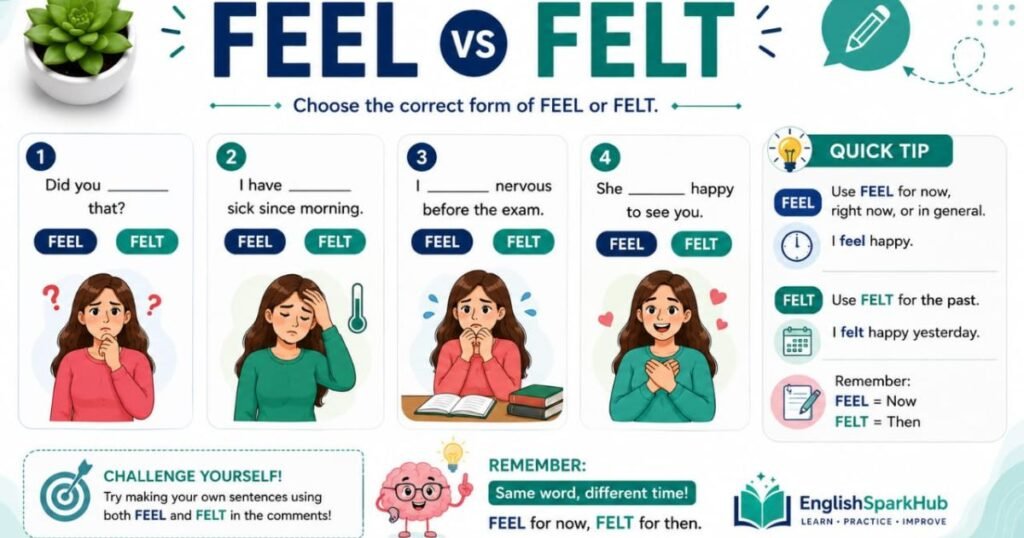
Learning English can be exciting yet confusing, especially when it comes to understanding verb tenses. Have you ever wondered why we say “I feel happy” but “I felt sad yesterday”? This article is designed for you to grasp the distinction between “feel” and “felt” with ease. You will not only learn their uses but also practice them through simple exercises, enhancing your writing and speaking abilities.
I ___ excited about the party tonight.
She ___ very tired after the long journey.
How do you ___ today?
They ___ happy to see their friends last week.
He does not ___ well since the weather changed.
We ___ scared during the movie yesterday.
Do you ___ hungry right now?
I ___ cold in the morning.
Answer Key
feel
felt
feel
felt
feel
felt
feel
felt
Feel vs Felt FAQs
1. Is “felt” used for both past tense and past participle?
Yes, “felt” is the past tense and past participle of the verb “feel.” This means you use “felt” when talking about something that happened before now.
2. What is the difference between “feel” and “feels”?
“Feel” is the base form of the verb, used with “I,” “you,” and plural subjects (e.g., “They feel happy”). “Feels” is used with third-person singular subjects (e.g., “He feels tired”).
3. Can “felt” be used as an adjective?
No, “felt” is not commonly used as an adjective in English. It is primarily a verb form, though there are contexts where it describes something that can be felt, but this is not typical.
4. Is “feel” used in formal writing?
Yes, “feel” can be used in formal writing, especially when discussing emotions or impressions. Just make sure to use it appropriately according to the context and tone of your writing.
5. How do I use “feel” in a sentence?
You can use “feel” to express emotions or sensations. For example, “I feel happy today” or “I can feel the warmth of the sun.”
6. When do I use “felt” in a sentence?
Use “felt” to describe previous emotions or sensations. For instance, “I felt sad after the movie” indicates that the emotion happened in the past.
7. Are there synonyms for “feel”?
Yes, some synonyms for “feel” include “sense,” “perceive,” and “experience.” However, the best choice depends on your sentence’s context.
8. Can I use “feel” in questions?
Absolutely! You can use “feel” in questions, such as “How do you feel about this topic?” or “Do you feel tired?”
Final Takeways
Understanding “feel” and “felt” is important for good English. Remember these key points:
- “Feel” is used in the present, while “felt” is for the past.
- Use the base form “feel” after “did” and modal verbs like “can” and “should.”
- A common mistake is to mix “feel” and “felt” in the wrong tense.
- A simple tip is to think of “feel” as something you experience now.
Practice using these words correctly. Keep practicing, and your English will improve!
Related Articles:
1.Both Work for Me or Both Works for Me: What’s the Difference & Which is Correct?
2.Company Wide vs Companywide: What’s the Difference & Which is Correct?
3.Froze or Frozen: What is the Difference?
4.Layed vs Laid: What is the Difference?