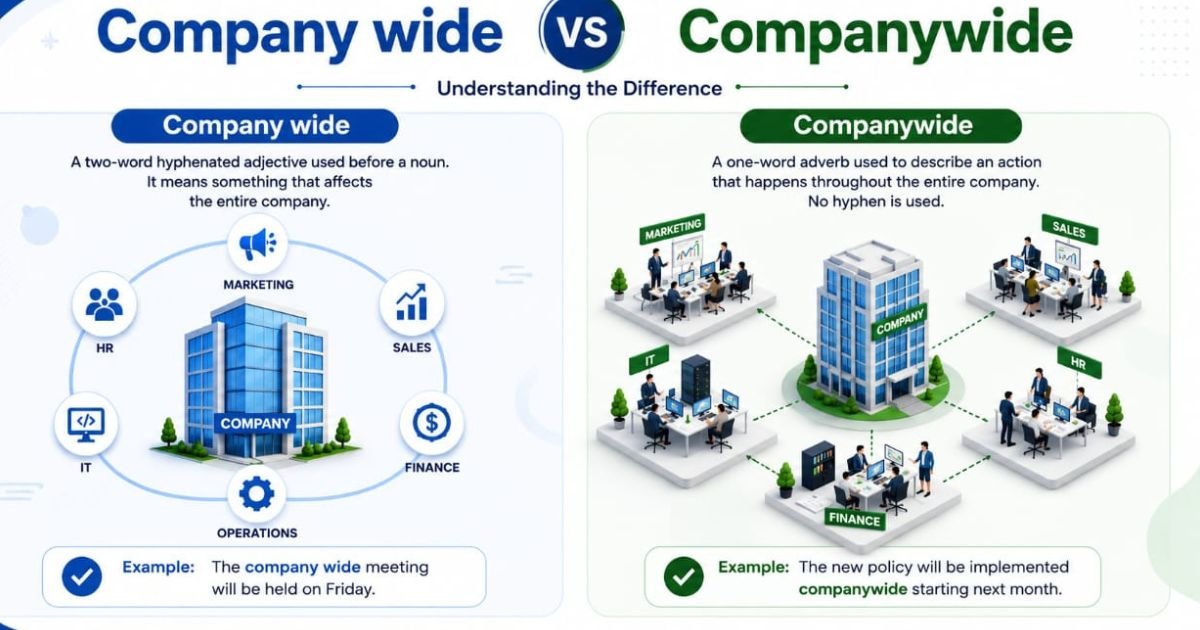
“Company Wide vs Companywide — a small difference that can completely change how professional your email sounds. This small choice can lead to confusion in professional settings. In this article, we will explain the small differences between these terms to clarify their proper usage and importance. Readers will leave with a clearer understanding of how using the correct words can improve their communication at work.”
Quick Answer
“When comparing company wide vs companywide, the hyphenated and closed forms both have their place depending on context.”
“Company-wide” (with a hyphen) is the standard and most widely accepted form in formal and professional writing, especially before a noun. “Companywide” (one word) is also correct and commonly used in modern, informal, or internal business communication. However, “company wide” (as two separate words without a hyphen) is considered incorrect in professional writing. If you want the safest,most professional choice use company-wide.
At a Glance:
| Form | Correct |
| Company wide | Incorrect |
| Company-wide | Correct(formal) |
| Companywide | Correct(informal) |
What Does “Company-Wide” Mean?
The term “company-wide” refers to initiatives, policies, or changes that apply throughout the entire organization, affecting all departments and employees. In simple words, it means an approach that goes beyond individual teams or divisions, creating a united direction with shared goals. This ensures every part of the company works together, improving teamwork and communication.
Common synonyms like “organization-wide,” “firm-wide,” and “enterprise-wide” show the inclusive nature of such initiatives. They give a sense of shared responsibility, showing that everyone has a role to play in the main goal. When strategies are applied company-wide, they improve efficiency and build a culture of openness, which boosts employee morale and engagement. This complete approach can be very helpful during times of change, giving a clear path for handling challenges and using opportunities across the organization.
Company Wide vs Companywide Understanding the Three Forms”
The debate around company wide vs companywide often confuses even experienced writers.”
The term “company-wide” serves as a well-accepted adjective to describe policies, initiatives, or practices that cover the entire organization. Understanding how it’s written — and why the form matters — makes a real difference in how professional your writing looks.
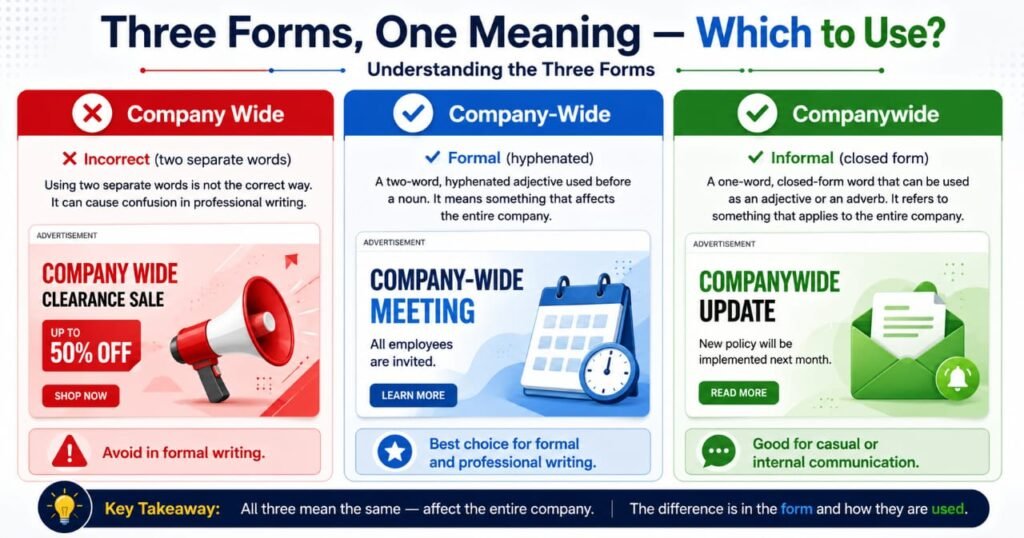
Company Wide (Two Words) — Why It’s Wrong
Writing it as two separate words, “company wide,” is technically incorrect as it disrupts the intended meaning and readability. This phrasing lacks clarity, leaving readers confused about whether it refers to a company operating widely or just indicating a broad scope.
Company-Wide (Hyphenated)
The hyphenated version, “company-wide,” is correct and remains the safest, most widely accepted form in formal writing. It maintains a clearer distinction and is commonly used before a noun in official documents, reports, and business communication.
Companywide (Closed Form)
“Companywide,” written as a single closed word, is also correct and is often seen in modern usage, particularly in digital communications and casual internal messaging.
| Form | Usage Content | Clarity and Formality |
| Company wide | Incorrect; may confuse the reader. | Low |
| Company-wide | Correct;common in formal writing. | High |
| Companywide | Correct;increasingly used in casual contexts. | Moderate to High. |
While all three forms may look similar, only “company-wide” and “companywide” are grammatically correct. Using the wrong form, especially in official documents or client communication, can create confusion and make your writing appear less polished.”This shows company wide vs companywide rules stay consistent worldwide.”
The Grammar Rule Behind It
What Is a Compound Adjective?
Compound adjectives are formed when two or more words combine to create a single descriptive unit that modifies a noun. These combinations can improve clarity and specificity in writing, particularly in phrases such as “company-wide.”
Why the Hyphen Matters
Hyphenation plays an important role here, as it signals to the reader that the words work together to modify the noun that follows. Without the hyphen, the phrase “company wide” can be understood in confusing ways, possibly suggesting that the company is physically wide rather than describing something that applies across the entire company.
The hyphen removes this confusion and gives clear meaning to the reader. In the case of “company-wide,” the hyphen shows that the scope of an initiative or policy is complete, affecting every department and level of the organization. Also, the way compound adjectives are used can change over time; terms like “companywide” are increasingly accepted as single, unhyphenated words in modern writing. This shows why it’s important to stay aware of how language changes while still keeping clarity — and why hyphenation still matters when precision is important.
Quick Memory Tests to Decide
Insert-the-Noun Trick
Add a noun after the phrase and check if it stays clear — like “a company-wide scope.” If it reads clearly with a hyphen, the hyphen is correct.In short, mastering company wide vs companywide helps you communicate clearly in any professional setting.”
Synonym Test
Replace the term with a similar phrase, like “across the company,” and check if the meaning stays the same without a hyphen.
Position Test (Before Noun vs After Noun)
Before a noun — “company-wide policies” — use the hyphen. After the noun — “the policies are companywide” — use the closed form.
When to Use Each Form
When to Use Company-Wide
In formal writing, “company-wide” is usually preferred, especially in legal documents, reports, and professional communications where clarity matters most. For instance, one might say, “The company-wide initiative will improve communication across all departments.” Here, the hyphen shows that the initiative covers every part of the company, keeping the tone clear and formal.
When to Use Companywide
In informal writing — such as internal emails, memos, or casual discussions — “companywide” is often acceptable and easily understood. For example, “We’re launching a companywide training program next month” conveys the same meaning in a more relaxed way. Using the closed form also reflects a modern, easy-going style that fits informal writing.
Real Examples in Business Writing
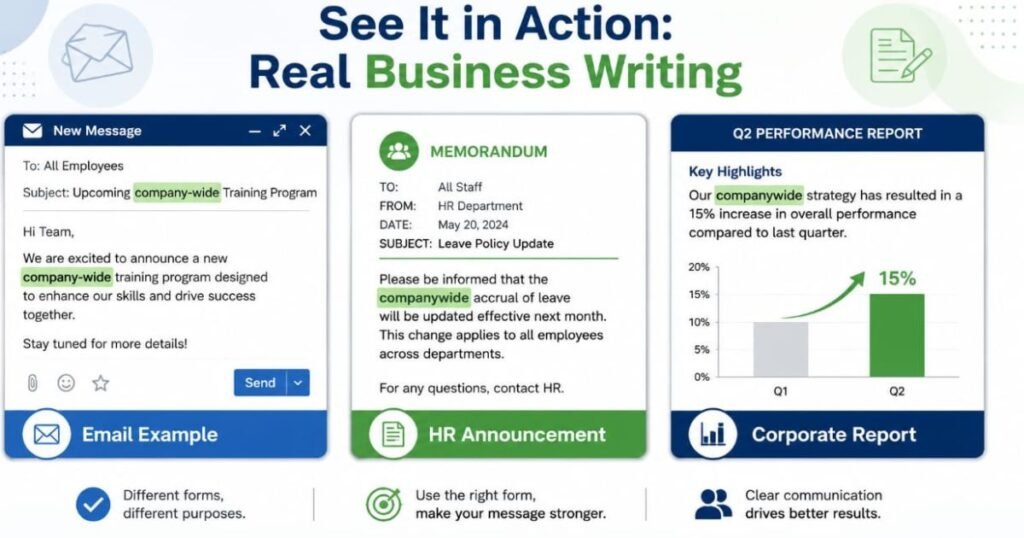
Email Example
In business communications, clarity is very important, and the difference between “company-wide” and “companywide” can subtly affect the tone of the message. For instance, in an email from management announcing a new initiative, you might read, “We are excited to implement a company-wide training program designed to improve employee skills.” Here, “company-wide” shows that every employee will take part, while following standard grammar rules.
HR Announcement Example
In an HR announcement about a policy change, one might see, “Effective immediately, our vacation policy will be updated to allow for companywide accrual of leave.” This usage gives a strong sense of unity, showing that all employees across departments are equally affected and informed of the change.
Corporate Report Example
In a corporate report summarizing annual performance, a sentence like “The companywide strategy has resulted in a 15% increase in productivity” combines the two words smoothly, showing a unified approach across the organization. This kind of precision in language builds professionalism and shows the company’s commitment to clear, honest communication.
Usage in Different Contexts
The choice between “company-wide” and “companywide” depends on context. Formal writing, like memos and website content, favors “company-wide” for clarity and professionalism. Casual settings, like internal emails and social media, work well with “companywide.”
| Context | Preferred form | Reason |
| Corporate Memo | Company-wide | Formal tone,needs clarity |
| Internal Email | Companywide | Casual,everyday communication |
| Website Content | Company-wide | Professional,polished, image |
| Social Media | Companywide | Short,conversational tone |
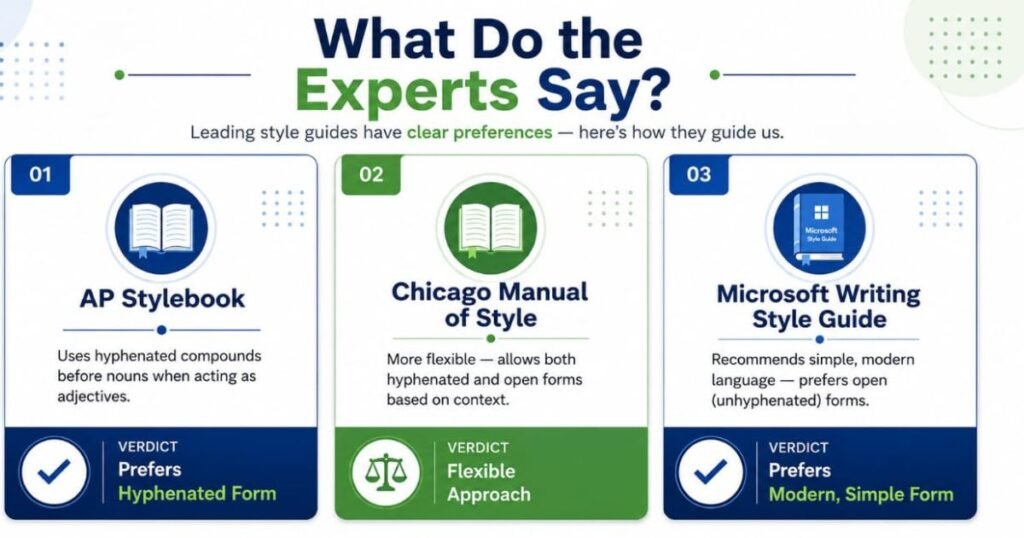
What Do Major Style Guides Say?
AP Stylebook
The AP Stylebook approach to compound modifiers generally favors hyphenating terms that appear before a noun, which supports using “company-wide” in formal writing such as news articles and press releases.
Chicago Manual of Style
The Chicago Manual of Style takes a more flexible approach, allowing closed compounds like “companywide” once they become well-established in common usage, while still favoring hyphenation for clarity in most cases.
Microsoft Writing Style Guide
The Microsoft Writing Style Guide, often followed in tech and business writing, tends to prefer clean, modern language and commonly accepts “companywide” as a standard term in digital and workplace communication.
Comparison Table
| Style Guide | General Preference | Notes |
| AP stylebook | Company-wide | Hyphen used before a noun |
| Chicago Manual of Style | Company-wide (flexible on companywide) | Allows closed form once common |
| Microsoft writing style Guide | companywide | Prefer simple,modern words |
Common Mistakes to Avoid
Getting company wide vs companywide wrong is one of the most common grammar slips in business writing
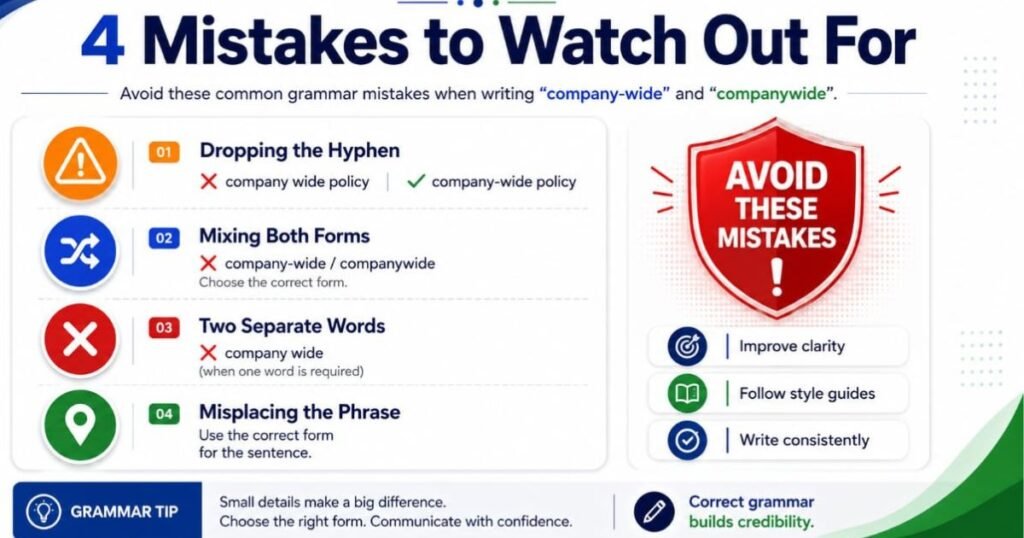
- Dropping the Hyphen
A common mistake is dropping the hyphen in formal writing, using “companywide” where “company-wide” is expected.
- Mixing Both Forms
Another mistake is mixing both forms in the same document — like “company-wide policy” in one line and “companywide meeting” in another — which looks inconsistent.
- Writing It as Two Separate Words
A third mistake is writing it as two separate words, “company wide,” which is grammatically incorrect and confuses readers.
- Misplacing the Phrase
Lastly, writers sometimes misplace the phrase in a sentence, such as “the policy is company-wide new” instead of “the new policy is company-wide.”
American vs British English:
This hyphenation rule stays mostly the same in both American and British English. Both varieties generally prefer “company-wide” in formal writing, following the standard compound adjective rule. Minor differences in punctuation style can appear across regions, but the core grammar rule — hyphenating compound modifiers before a noun — remains consistent in both forms of English.For example, UK-based publications often follow similar hyphenation rules as US style guides, showing that this is not a region-specific issue but a general grammar principle. Whether you’re writing for a US or UK audience, “company-wide” remains the safer, more widely accepted choice.”This shows company wide vs companywide rules stay consistent worldwide.”
Similar Words That Follow the Same Rule:
Many other business terms follow the same hyphenation pattern as “company-wide.” These include
- organization-wide — organization-wide change
- industry-wide— industry-wide shift
- department-wide — department-wide training
- system-wide — system-wide update
- nationwide — nationwide campaign (already one word)
Knowing this pattern makes it easier to use the same rule with other similar business terms.
Case Study: Impact on Corporate Communication
Imagine an HR team announcing a new remote-work policy. One version reads: “The company wide remote work policy applies to all departments.” Another reads: “The company-wide remote-work policy applies to all departments.”
Most editors would choose the second version. The hyphen makes the sentence instantly clear, while the first version feels unfinished and can briefly confuse readers about how the words connect.
This small example shows how a single hyphen can shape how professional and easy-to-understand a message feels — especially in official communication read by an entire organization.
Quick Checklist / Practice Section
Use this quick checklist before writing:
- Is it before a noun? → Use company-wide
- Is it after a noun or standalone? → Use companywide
- Is it formal writing (reports, policies)? → Use company-wide
- Is it casual writing (chat, social media)? → Use companywide
Never write it as two separate words: company wide
Quick Practice:
- We launched a __ training program. (before noun)
- The update applies __. (after noun)
- Leadership approved a __ policy. (before noun)
Answers: 1. company-wide 2. companywide 3. Company-wide
Why This Small Detail Matters
“Knowing the difference between company wide vs companywide shows attention to detail in professional communication.”
A single hyphen might seem like a small thing, but it shapes how clear and professional your writing looks. Using the correct form — “company-wide” or “companywide” — helps readers understand your message instantly, without confusion or rereading.
In business writing, small details like this build trust. They show attention to detail and respect for the reader’s time, which strengthens your professional image whether you’re writing an email, a report, or a policy document.In short, mastering company wide vs companywide helps you communicate clearly in any professional setting.”
FAQs
1. What is the difference between “company-wide” and “companywide”?
“Company-wide” with a hyphen is more commonly accepted in formal writing, while “companywide” is a good alternative in less formal contexts.Getting company wide vs companywide right shows attention to detail in professional writing.”
2. Is one term more commonly used than the other?
“Company-wide” is generally more common in official documents, while “companywide” is increasingly seen in informal usage and accepted by some style guides.
3. Do specific style guides prefer one form over the other?
Yes. For example, the Chicago Manual of Style generally favors hyphenated forms, while some modern dictionaries accept both.
4. Are there rules for using hyphenated terms in formal writing?
In formal writing, hyphenated terms like “company-wide” help make meaning clear and prevent confusion, especially when they come before a noun.
5. Can “companywide” be used in a business context?
Yes, “companywide” works well in business communication, especially in less formal writing like emails or internal newsletters.
6. How should I choose between “company-wide” and “companywide”?
Think about your audience and the setting. Use “company-wide” in formal reports and presentations, and “companywide” in casual communication.
7. Are there similar terms that follow this pattern?
Yes, words like “nationwide” and “schoolwide” follow the same pattern — hyphenated or closed depending on context and formality.
8. Is there one fixed rule for using hyphenated vs. single-word forms?
There’s no fixed rule — it depends on the style guide and context. The best practice is to stay consistent once you pick a form for your document
Related Reads:
If you enjoyed learning about this grammar distinction, you might also like:
Key Takeaways:
- “Company-wide” (hyphenated) is the safest and most professional form for formal writing.
- “Companywide” (closed form) is correct and widely used in casual or internal communication.
- “Company wide” (two separate words) is always grammatically incorrect.
- Use company-wide before a noun; companywide works well after a noun or standalone.
- Major style guides generally favor “company-wide” for formal writing.
Always stay consistent — don’t mix forms within the same document.
Similar words like “organization-wide” and “industry-wide” follow the same rule.In short, mastering company wide vs companywide helps you communicate clearly in any professional setting.”
Conclusion:
“The comparison of company wide vs companywide may look small, but it affects how clear your writing appears.”Mastering company wide vs companywide is a small step that makes a big difference.”
The difference between company wide, company-wide, and companywide may look small, but it affects how clear and professional your writing appears. “Company wide” as two separate words is incorrect — always avoid it.
Company-wide is the safer choice for formal writing, while companywide fits casual, modern communication. Stay consistent with one form throughout your writing.