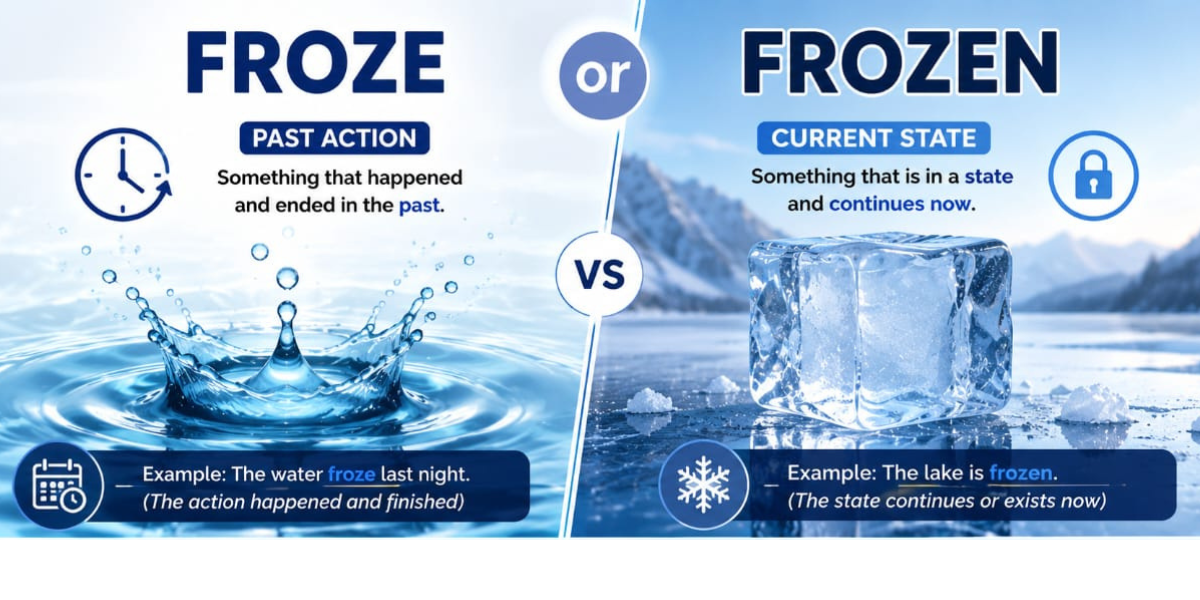
Froze or Frozen is essential for clear, accurate English. “Froze” is the simple past tense of “freeze,” describing a completed past action — as in “She froze the leftovers last night.” “Frozen,” on the other hand, is the past participle, used in perfect tenses and as an adjective — as in “The frozen dinner was easy to prepare.”
The two forms also carry a subtle difference in relevance to the present. “Froze” describes something that happened and ended, with no real connection to now — “The lake froze 200 years ago” is simply a historical fact. “Frozen,” especially with “has” or “have,” signals that the past action still matters today — “The lake has frozen, so we can finally go skating this weekend.”
The distinction goes beyond grammar rules, though. Consider how these words shape mood: “the cool
air” evoke immediacy and crispness, while “the frozen lake” evokes stillness — a moment held in place. Used correctly, “froze” and “frozen” don’t just avoid grammatical errors; they let you control the tone and precision of a sentence.
Comparison Overview
“Froze” and “frozen” both come from the verb “freeze,” but they follow different sentence structures. “Froze” stands completely on its own — no helping verb needed — as in “Yesterday, I froze the leftovers.”
“Frozen” never appears alone as a main verb; it always needs a helping verb like “has,” “have,” or “had” — as in “I have frozen the leftovers.” The only exception is when “frozen” is used as an adjective, describing a noun directly, such as “frozen leftovers.”
This structural difference is the easiest way to tell them apart: if a helping verb is present, or if the word is describing a noun, use “frozen.” If the sentence is a simple standalone statement about the past, use “froze.”Getting froze or frozen right simply comes down to spotting whether a helping verb is present.
Definition of Froze
Froze” describes the moment something changes from liquid to solid — like when you say, “The lake froze last winter.” But its meaning can go beyond the physical. Think of it as a snapshot in time — where there was once movement, now there is stillness.
“Froze” can also describe emotional stillness, like a relationship that freezes in time, holding onto a moment of joy or pain long after it happened. It captures that feeling of being stuck — unable to move because of a choice or situation, like freezing with fear before a big decision.
Definition of Frozen
“Frozen” means more than just cold or solid — it also brings a feeling of stillness, like something kept safe and unchanged. Think of ice-covered landscapes or that first bite of a cold dessert. Even memories can feel “frozen” in time — moments we hold onto, unchanged by the years.
In cooking, “frozen” means more than just temperature — it’s also a method. Freezing lets us enjoy fruits and vegetables all year, even out of season, though it raises the question of whether frozen food is as fresh as fresh food.
Main Difference Between the Froze and Frozen
The main difference is simple: “froze” stands alone, while “frozen” always needs help. “Froze” works by itself in a sentence — “The lake froze last night.” “Frozen” needs a helping word like “has,” “have,” or “had” — “The lake has frozen.”
There’s one more difference: only “frozen” can be used as a describing word (adjective), like “frozen lake” or “half-frozen pond.” You can never say “froze lake” or “half-froze pond” — “froze” simply doesn’t work that way.
“Frozen” also appears in passive sentences, where something is done to the subject — “The pipes were frozen by the cold.” “Froze,” on the other hand, never fits this pattern; you can’t say “the pipes were froze.”
| Category | Froze | Frozen |
| Grammatical Form | Simple past tense | Past participle |
| Sentence structure | Functions independently in past tense statements | Requires an auxiliary verb (has /have/had) or functions as an adjective |
| Typical usage | Denotes a single , completed action at a specific point in time | Denotes a resulting state, or is used with in perfect tense constructions |
| Example | The company froze its hiring plans last quarter | The company has frozen its hiring plans. |
| Common error | Incorrectly used with auxiliary verbs (e.g “has froze”) | Incorrectly used in simple past context (e,g “it frozen yesterday”) |
Grammar Guide:
When deciding between froze or frozen, always check whether a helping verb is present.When deciding between froze or frozen, always check the sentence structure first.Most confusion around froze or frozen disappears once you focus on sentence structure rather than meaning.
“Froze” and “frozen” are both forms of the word “freeze,” but they work differently. “Froze” is used for something that happened at one point in the past. “Frozen” is used with helping words like “has” or “have,” or as a describing word for something that stayed in that state
How Each Term Is Used in a Sentence
“Froze” is used by itself to talk about something that happened before. For example, “She froze the leftovers after dinner” simply means she did that action in the past.
"Frozen" needs a helping word like "has," as in "He has frozen his assets." It can also describe something, like "The frozen lake was beautiful in winter."
Common mistakes learner makes
One common mistake is using “I have froze” instead of “I have frozen.” Remember, “frozen” is the past participle and is used with helping verbs such as “have.” Another mistake is saying “Yesterday, I frozen” instead of “Yesterday, I froze.” Understanding this difference helps learners use these verb forms correctly and confidently. Similar verb pairs, such as “lay” and “laid,” can also cause confusion.If you’re also confused about other past-tense forms, check out our guide on Feel vs. Felt: Complete Guide with Examples, which explains another common difference between present and past verb forms.
Simple rules to remember
These basic rules make froze or frozen far less intimidating once you start applying them.
Use “froze” when the sentence is only about the past. Use “frozen” when a helping verb is present or when describing something as cold or solid.
Quick tips for writing and speaking
If you can replace the verb with “did,” use “froze.” If you can use “has” or “have” before it, use “frozen.” Also remember that “frozen” often describes objects like food, water, or conditions
When to Use Each One
Use “froze” when talking about the exact moment something happened — “The pond froze overnight.”
Use “frozen” when describing the current state or result — “The pond is frozen.
Decision Guide
Ask yourself: Is there a helping verb like “has,” “have,” or “had” nearby?
- Yes→ use “frozen”
- No, it’s just a simple past action* → use “froze”
Ask yourself: Am I describing something (an adjective)?
- Yes → use “frozen”
- No, I’m stating an action that happened* → use “froze
Real World Practical Examples
Seeing froze or frozen used in real sentences makes the distinction much easier to remember.
Froze:
- The pipes froze during the winter storm.
- She froze when she saw the spider.
- Prices froze after the government’s announcement.
- He froze the meat before the trip.
- The lake froze solid by December.
Frozen:
- The meat has been frozen for a week.
- Her bank account was frozen due to fraud.
- He stood frozen with fear.
- The frozen yogurt shop just opened downtown.
- Talks between the two countries remain frozen.
Self-Assessment (Fill in the Blanks)
Test your understanding of froze or frozen with the quick exercise below.
Fill in each blank with either “froze” or “frozen.”
1. The lake __ overnight after the temperature dropped.
2. She has __ all the vegetables for winter.
3. He __ in fear when the dog barked.
4. The pipes have __ due to the cold weather.
5. Yesterday, the water __ within minutes.
6. My bank account was __ after the suspicious activity.
7. The company __ all new hiring last month.
8. The chef has __ the leftover soup.
9. The ground __ solid during the harsh winter.
10. The assets have been __ by the court.
11. She __ the extra bread for later use.
12. He stood completely __ when he saw the accident.
13. The river __ completely by late December.
14. The prices have __ since the new policy began.
15. The ice cream __ perfectly overnight.
16. Talks between the two nations remain __.
17. The scientist __ the samples for future study.
18. The window was __ shut due to the ice.
19. The pond __ so quickly that the ducks were surprised.
20. Their negotiations have __ for over a month now.
Answer Key
1. froze
2. frozen
3. froze
4. frozen
5. froze
6. frozen
7. froze
8. frozen
9. froze
10. frozen
11. froze
12. frozen
13. froze
14. frozen
15. froze
16. frozen
17. froze
18. frozen
19. froze
20. Frozen
Final Verdict
The distinction between “froze” and “frozen” ultimately comes down to grammatical function and timing. “Froze” is reserved for a specific, completed action in the past, while “frozen” applies to a resulting state or is paired with a helping verb such as “has” or “have.” Misusing one for the other can disrupt the clarity of a sentence, even when the intended meaning remains apparent. A reliable way to determine the correct form is to check whether a helping verb precedes it, or whether the word is functioning as a description rather than an action. With this simple framework in mind, choosing between “froze” and “frozen” becomes far more intuitive.At the end of the day, froze or frozen isn’t as tricky as it first seems.
FAQs
Q1: What is the main difference between “froze” and “frozen”?
“Froze” is the simple past tense, used for a completed action. “Frozen” is the past participle, used with a helping verb or as an adjective.The main difference between froze or frozen comes down to tense: “froze” is simple past, while “frozen” is the past participle.
Q2: Can I say “I have froze the food”?
No, this is incorrect. The correct form is “I have frozen the food.”Mixing up froze or frozen this way is one of the most common learner mistakes.
Q3: Is “frozen” always used with “has” or “have”?
Not always — “frozen” can also work as an adjective, like “frozen food” or “a frozen lake.”Choosing between froze or frozen as an adjective versus a verb depends on context.
Q4: When should I use “froze” instead of “frozen”?
Use “froze” when describing a specific action that happened in the past, such as “The lake froze last night.”Deciding froze or frozen here comes down to whether the action is complete.
Q5: Why do people often confuse these two words?
Both words come from “freeze,” and English past participles don’t always follow predictable patterns.This is exactly why froze or frozen trips up so many learners.
Q6: Can “frozen” describe things other than temperature?
Yes, “frozen” can also mean something is stopped or unchanged, like “frozen assets.”This is exactly why froze or frozen trips up so many learners.
Q7: Is “Yesterday, I frozen” a correct sentence?
No, it should be “Yesterday, I froze,” since “frozen” cannot stand alone in simple past tense.This is a classic froze or frozen error to watch for.
Q8: How can I quickly decide which word to use?
If “did” fits in place of the verb, use “froze.” If “has” or “have” fits, use “frozen.”This simple test makes choosing froze or frozen much easier.
Q9: Does “frozen” ever appear in passive sentences?
Yes, as in “The pipes were frozen by the cold,” where the action is done to the subject.Passive voice is another place where froze or frozen usage differs.
Q10: Is mastering “froze” vs “frozen” important for fluency?
Yes, using them correctly helps your writing and speech sound more natural and accurate.Practicing froze or frozen regularly will improve your overall grammar confidence.
Conclusion
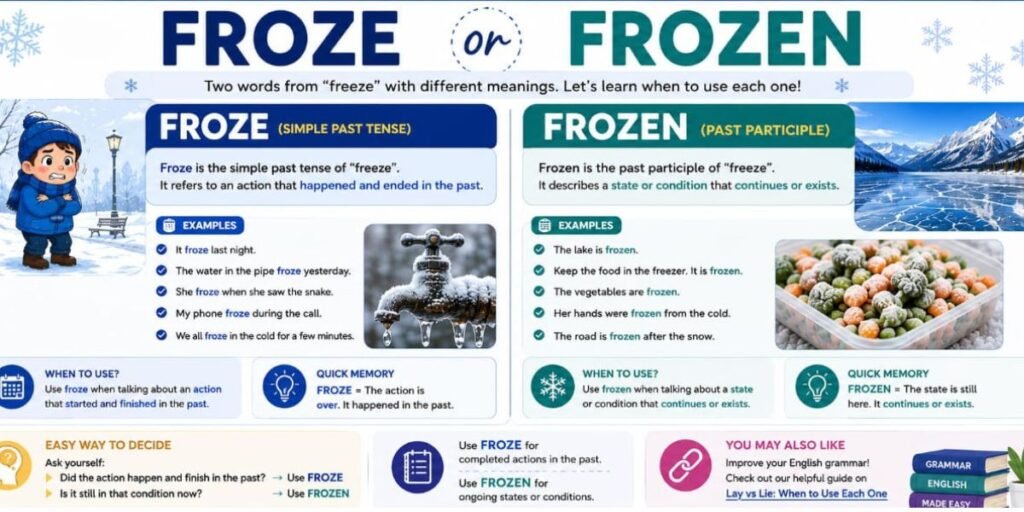
The difference between “froze” and “frozen” may seem small, but it plays a big role in accurate English communication. “Froze” marks a completed action in the past, while “frozen” functions as a past participle — used with helping verbs or as a descriptive adjective. Leading grammar references such as Merriam-Webster, Oxford Dictionary, Cambridge Dictionary, Grammarly, The Chicago Manual of Style, and Fowler’s Modern English Usage* all recognize this distinction as a common trouble spot for English learners, since irregular past participles like “frozen” often don’t follow predictable patterns. With consistent practice and the tips shared above, mastering “froze” and “frozen” becomes straightforward, helping you communicate with greater clarity and confidence.Ultimately, the choice between froze or frozen depends on grammatical structure and context.Ultimately, mastering froze or frozen becomes easy once you understand their grammatical roles.